
Downey Previous Residents by Era
A useful house history separates sources by what they can prove. Recorded documents follow legal transfers, while the Assessor connects a present street address to an AIN and legal description. Directories add listed occupants, the census adds household relationships, and permits show activity at a site. The table keeps those roles distinct so a name in one record does not become an unsupported claim about another person.
| Source | Years It Covers | Where Held | What It Shows |
|---|---|---|---|
| Recorded real-estate documents | 1851-present | RR/CC Norwalk | Parties, transfers, legal description |
| Assessor parcel record | Current roll and history | Assessor Portal and counter | AIN, situs, building and value facts |
| Haines cross-cross directories | 1981, 1983-86, 1988; 1989-92 | LA County Library Californiana | Address-keyed listed households |
| GTE and Pacific Bell books | 1988-92 | Californiana | Telephone and address snapshots |
| Downey and regional directories | 1948-68; 2001-10; 2008, 2009, 2015-16 | Libraries and genealogy catalogs | Names, households, phones and businesses |
| Federal census | 1950 public; 1960 public in 2032 | NARA and partner access | Household relationships at enumeration |
| Maps and city files | 1891, 1930 and current permit era | LOC, Historical Society and Downey | Footprints, use, projects and address clues |
Begin with the era that matters. The RR/CC chain is the owner trail. Haines is strongest for address-to-name research from 1981 through 1992. Downey and Norwalk books from 2001-10, plus Area volumes from 2008, 2009 and 2015-16, add later snapshots. Directory dates are compilation dates, not census enumeration dates, so pair them rather than treating them as one event.
Why Downey Deeds Split Between Floors
Los Angeles County keeps the key real-estate access point next door in Norwalk. The Los Angeles County Registrar-Recorder/County Clerk Real Estate Records office is at 12400 Imperial Highway, Norwalk, California. Staff can be reached at 800-201-8999, Monday through Friday from 8 a.m. to 5 p.m. Real-estate records reach back to 1851. The 1851-1957 material is reviewed on the lower level, while 1958-present material is reviewed on the second floor.
The split helps plan a long chain and explains why an online search cannot replace the counter. The RR/CC uses alphabetical party-name and recording-year indexes. It has no Internet index and no street-address or APN search. Viewing is free by appointment. An address or AIN must first yield a name and year.
| Plain copy | $5 for the first page, then $3 for each added page |
|---|---|
| Certified copy | $6 for the first page, then $3 for each added page |
| Name and year search | $0.50, with a $1 minimum |
| Expedited service | $18.50; card handling is $1.75 |
| Online orders | Processed within 20 working days |
For mail, provide the document number, or the names, year and document title. Online orders use a third-party service; mail payment is by check or money order to the Registrar-Recorder/County Clerk.
Note: An appointment provides viewing access, but a copy request still needs enough identifiers before staff can locate the document.
Tracing a Downey Chain of Title
A chain of title is a linked sequence of ownership transfers for one parcel. Resolve the current parcel first, obtain the owner through the lawful Assessor channel, then move through the RR/CC index one transfer at a time. Keep the legal description with the chain when a street label changes.
- Enter the street address or ten-digit AIN in the Los Angeles County Assessor Portal. Save situs, legal description, parcel status, map reference and sale clues.
- Use the Assessor counter or authorized data channel for current owner and mailing information. The public portal has no online owner-name search.
- Estimate the acquisition year, then search that owner as grantee in the Norwalk alphabetical name-and-year index. A grantee receives the interest in the transfer.
- Record the deed's document number, title, year, grantor, grantee and legal description. The grantor transfers the interest away.
- Search the earlier seller as grantee. Repeat the backward search through earlier years, stopping only when the parcel was formed from a parent tract or the trail reaches the 1851 coverage floor.
- Follow map references and parent AINs when boundaries change. Keep a source note for every link instead of merging similar names.
- Grantor and grantee
- The grantor gives or transfers an interest; the grantee receives it.
- Chain of title
- The connected sequence of recorded transfers that supports a parcel's ownership history.
- Legal description
- The lot, tract or parcel wording that identifies the land more reliably than an old street number.
- Criss-cross directory
- A reverse directory that starts with an address or telephone listing and points toward a name.
Downey Parcels, Maps, and Parent AINs
The Assessor Portal accepts an address or AIN, but it is a property tool, not a complete resident roll. A parcel detail may show property information, recent sale information, roll values, a boundary description, building description and recent parcel-change activity. Owner names are suppressed from the public online search. The South District Office serving Downey is at 1401 East Willow Street, Signal Hill, California 90755. Its phones are 562-256-1701 and 888-807-2111, with weekday hours of 8 a.m. to 5 p.m.
The LA County Assessor Map helps connect the number on a mailbox to surrounding parcel geometry, AINs, lots, tracts, easements and streets. The sample parcel detail illustrates the kind of current property record that can anchor the chain. Save the parent AIN or map reference when a parcel has been split or reshaped. A parcel create date is an Assessor record date, not proof of construction or first occupancy. No verified Downey street-renumbering year was located, so legal descriptions and AINs are safer bridges than a guessed conversion year.
GIS-NET includes identify, query, buffer, measure, export, print, aerial and Street View tools, but mainly serves unincorporated territory. Incorporated Downey research should favor the Assessor Map and city maps. A map shows where a parcel sits, not every person connected with it.
Note: An AIN can preserve continuity when a street label changes, but it does not establish construction date or first occupancy.
Downey Households in Cross-Cross Directories
Listed occupants fill a gap that deeds cannot. The LA County Library Californiana holdings include Haines Los Angeles South Suburban Cross-Cross volumes for 1981, 1983-1986 and 1988, followed by Haines LA County South Central volumes for 1989-1992. These are address-keyed tools. They can preserve a listed name, telephone number and address for a snapshot, but gaps or an omitted listing do not prove that a home was empty.
Telephone books add more checkpoints. GTE Downey and nearby cities issues cover May and November 1988, May 1989, May 1990, November 1991 and May 1992. Pacific Bell Midcities portions cover August 1988, February 1989, February and August 1990, and August 1992. Later Downey-Norwalk white and yellow pages include 2001, 2002-03, 2004-06 and 2008, while Downey-Norwalk Area holdings include 2008, 2009 and 2015-16.
Verified digitized editions include 1948, 1950, 1952, 1953, 1955, 1957-58, 1959, 1961, 1963-65 and 1968. The Downey city directory collections page compares publishers and access points. Carry one standardized address and spelling across editions.
Downey Census Pairing for Past Households
The 1950 census is public under the federal 72-year release rule. The 1960 census is scheduled to become public in 2032. A census page can show household relationships at enumeration, while a directory may show a listed adult, spouse, occupation, telephone exchange or abbreviated street address. Neither source should be forced to answer the other's question.
- Choose a directory edition and write down the exact name, address, unit, telephone and abbreviation as printed.
- Match the address to the closest census enumeration district or an address aid. Test spelling variants, initials and likely street abbreviations.
- Compare household relationships, not just a surname. A spouse or child link can separate two same-name households in the same city.
- Record the dates separately. A directory's publication or canvass date can differ from the census enumeration date, so a change brackets an interval rather than proving a move on one day.
Keep the AIN and deed chain in separate columns. Past residents may be occupants without title, while an owner may have used a different mailing address.
Note: A directory gap is evidence of a missing snapshot, not proof that the address was vacant.
1930 Downey Map and Cross-Cross Clues
Downey offers a useful three-part comparison: legal owner in the RR/CC chain, listed occupant in a cross-cross directory, and building footprint in a historical map. The Downey Historical Society finding aid lists a 1930 Sanborn map with directories, maps, photographs, newspapers and real-estate advertising. The Library of Congress Sanborn collection also has a February 1891 Downey sheet.
Sanborn maps describe footprint, use and construction context, not previous residents. A reverse directory can identify a listed household, not title. A deed establishes a transfer, not who lived there. Read all three with dates visible, especially when a parcel has a parent tract, changed lot shape or a hard-to-search address.
Use the map for physical context, the directory or census for a household clue, and the recorder for title. Their combination remains local evidence, not a shortcut around collection limits.
Downey Permits, Probate, and Obituaries
City permit records add a date and role to the address trail. Downey's Public Works Accela route began June 1, 2026, and Building and Safety moved applications and plans online July 1, 2026. Older coverage is unverified. Applicant, contractor, owner and occupant are different roles, so a permit documents work, not a household.
| Record role | What it establishes | What it does not establish |
|---|---|---|
| Deed owner | A recorded transfer and legal interest | That the owner lived at the parcel |
| Directory occupant | A publisher's listed household snapshot | Title, completeness or current presence |
| Permit applicant | Participation in a project at an address | Residency or ownership without another record |
Probate and obituary records can close a trail after a deceased owner or occupant leaves. Start with decedent name, probate party search, filed petition or notice, property record, then obituary. Check each against filed records.
For birth events connected to a family trail, start with the Los Angeles County birth-record instructions.
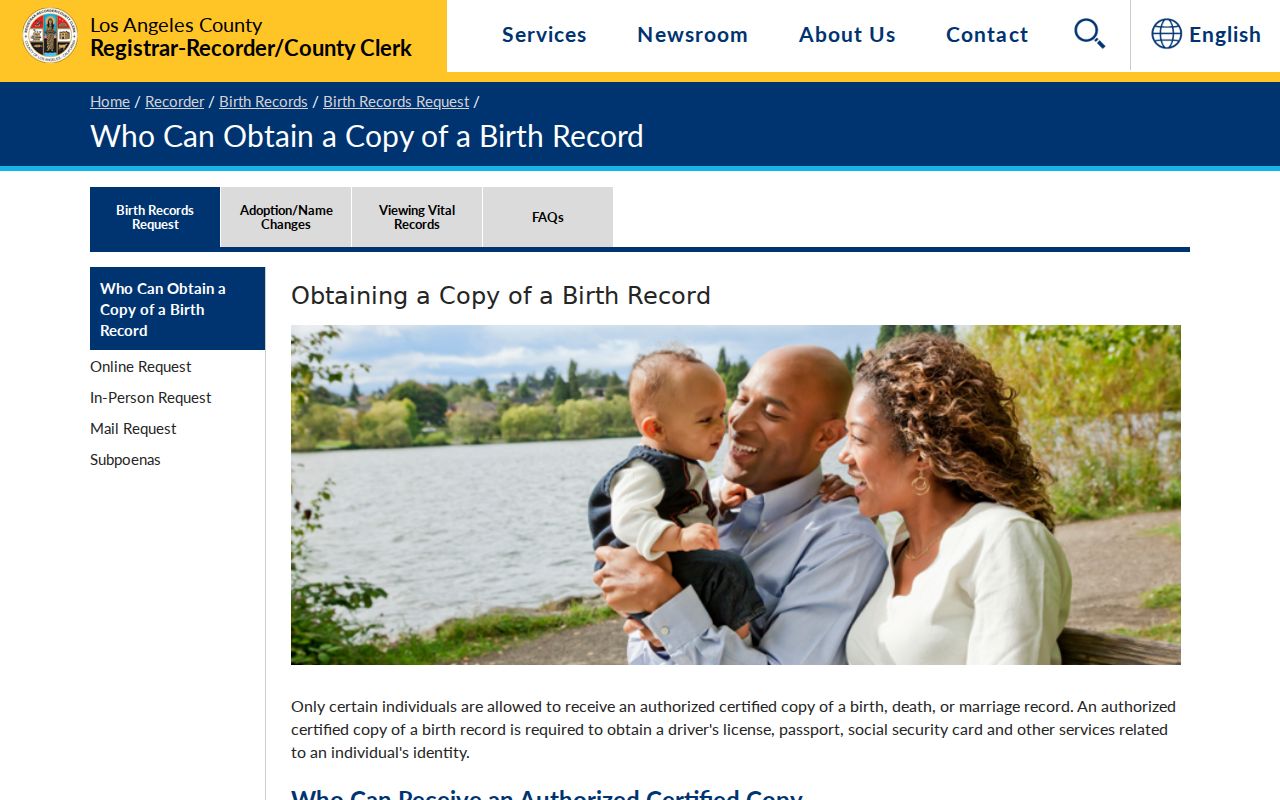
The county instructions identify the custodian and request route; they do not create a public resident list.
For a death event, use the Los Angeles County death-record page and check eligibility before ordering.
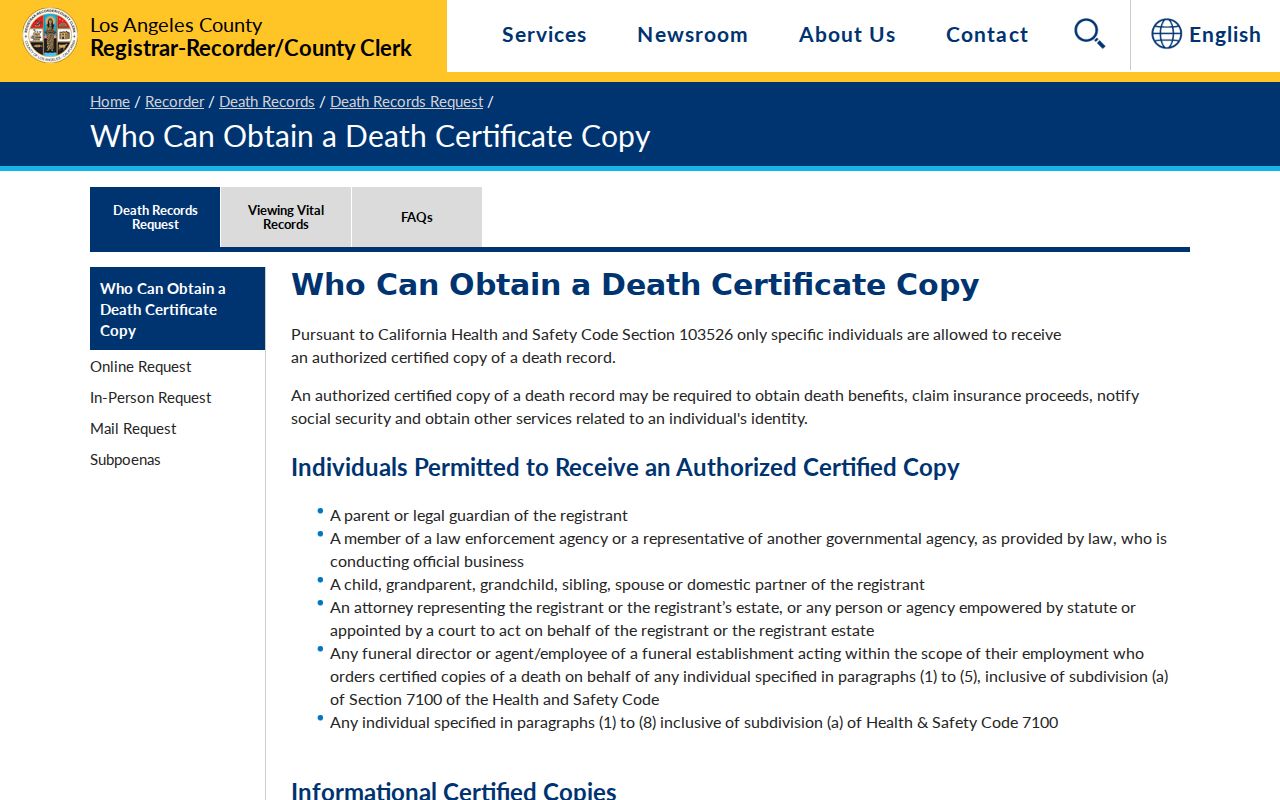
A death record can confirm an endpoint, but not occupancy at a particular Downey address.
Marriage evidence has its own channel through the Los Angeles County marriage-record page.
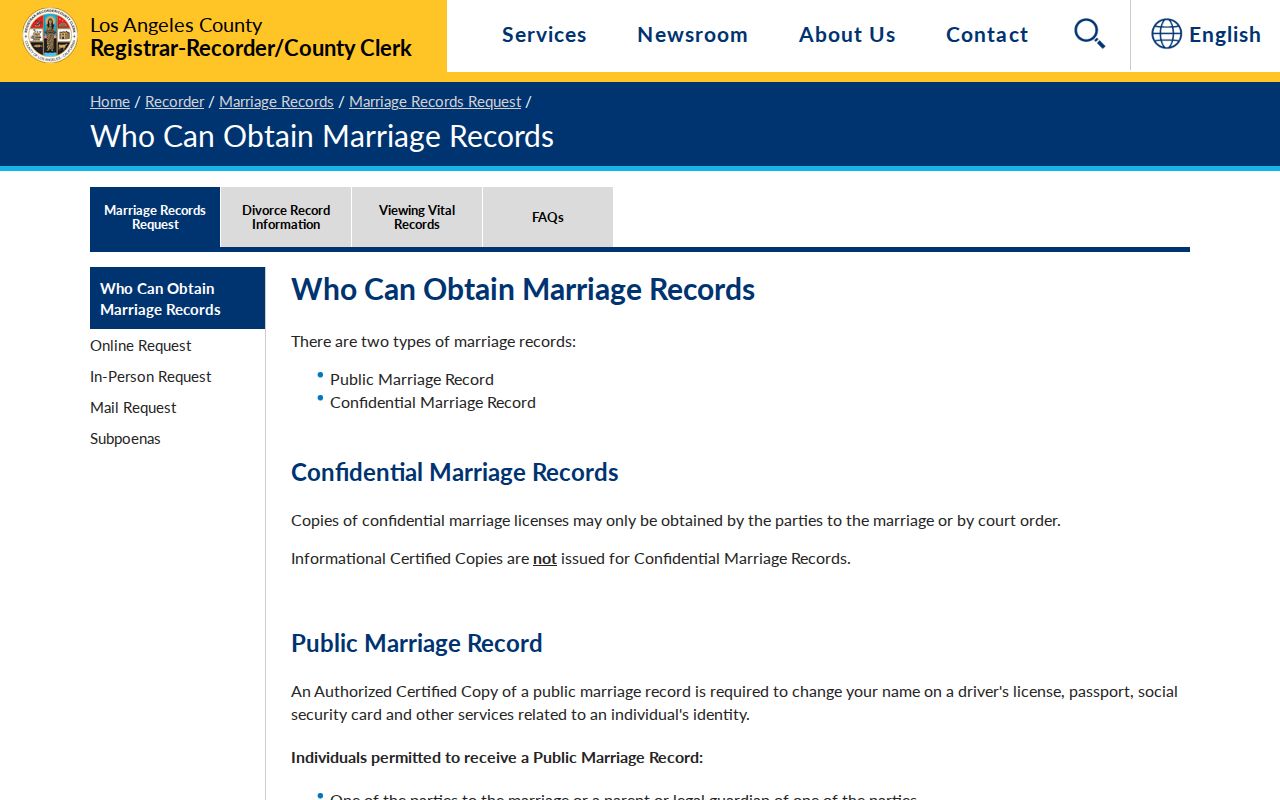
Marriage records can connect names and dates when the requester meets the copy rules.
When a federal case trail is relevant, PACER can provide federal case and docket access, subject to its account and fee rules.
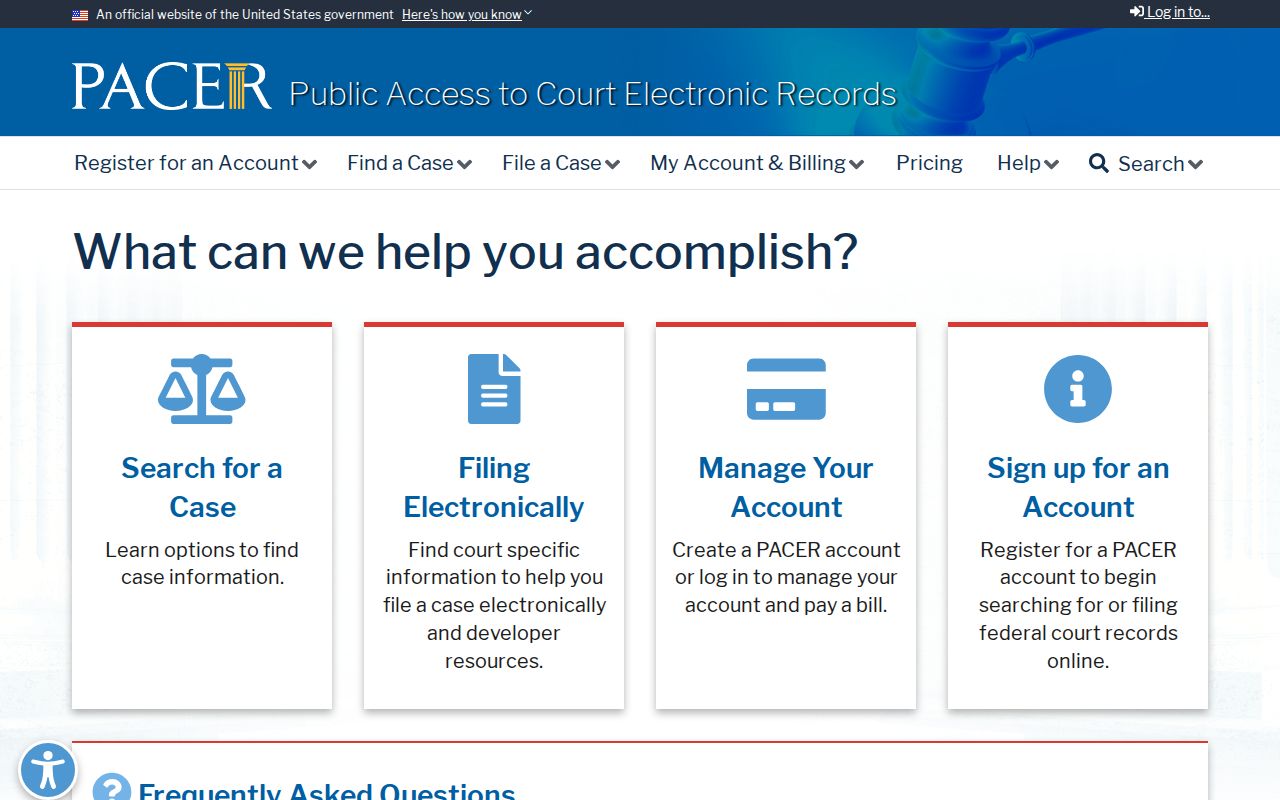
PACER supports a federal case trail only, not a complete probate, ownership or local-residency index.
Lawful Downey Previous Residents Research
Previous residents research belongs in house history, genealogy, estate work and family reconnection. Tie it to checkable records and stop at protected or weak evidence. A public document is not permission to publish a private address.
Lawful use. Use Downey records for personal research and house history. California Penal Code section 646.9 addresses stalking, Civil Code section 1708.7 provides a civil remedy, and Code of Civil Procedure section 527.6 provides a civil-harassment restraining-order process. Do not use a previous-resident trail to stalk, harass, threaten or harm anyone.
Keep source names, dates and access limits with every note. That makes clear whether the evidence describes an owner, occupant, project participant or historical possibility.